
In addition to our pre-conference digital events, the conference committee has planned a few optional events for conference attendees (locations and times listed below).
There is no additional cost to participate in the Curran Index workshop, but space is limited and will be reserved on a first-come, first-served basis. During the registration process, registrants will be asked to indicate their interest. A waitlist will be created if interest exceeds capacity.
Curran Index Workshop
Friday, July 24
12:30 – 2:00 p.m.
Location TBD
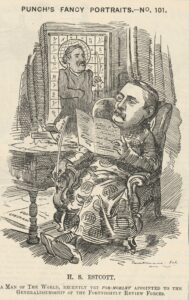
Engraving by Edward Linley Sambourne of Editor Thomas Hay Sweet Estcott for “Punch‘s Fancy Portraits” series, Punch 83 (Sept. 16, 1882), courtesy of Martin Hewitt.
Putting Faces to Names: Researching Author Biographies
Attribution research requires more than just an act of naming. Only by ascertaining robust biographical information about an author does the attribution become meaningful. Especially once attention moves beyond the Wellesley Index titles (where most contributors were sufficiently prominent to appear in standard biographical dictionaries), this requires a complex and often frustrating process of historical investigation, but one for which digital resources have created new opportunities.
This session offers participants an introduction to techniques for enriching attribution research with key biographical information. It will consider the utility and limitations of AI searches, recap the key resources, and in particular explore the sorts of “fuzzy,” iterative searching strategies and techniques that bring best results. It will use examples from Curran Index Editor Martin Hewitt‘s current work on the authorship of Chambers’s Journal 1858-74, present biographical templates being developed for the Curran Index, and give participants a chance to apply the techniques to carefully selected Chambers’ Journal authors.
The session is pitched at anyone interested in biographical or prosopographical approaches in periodical studies, or who just enjoys the challenge of detective work in the nineteenth-century digital archive. No prior knowledge or expertise is required. No advance preparation involved. You are encouraged to bring a laptop, especially if you have access to Ancestry/FindmyPast, and/or the British Newspaper Archive; but it will also be possible to join a small group provided with a laptop and a nominated group leader.